

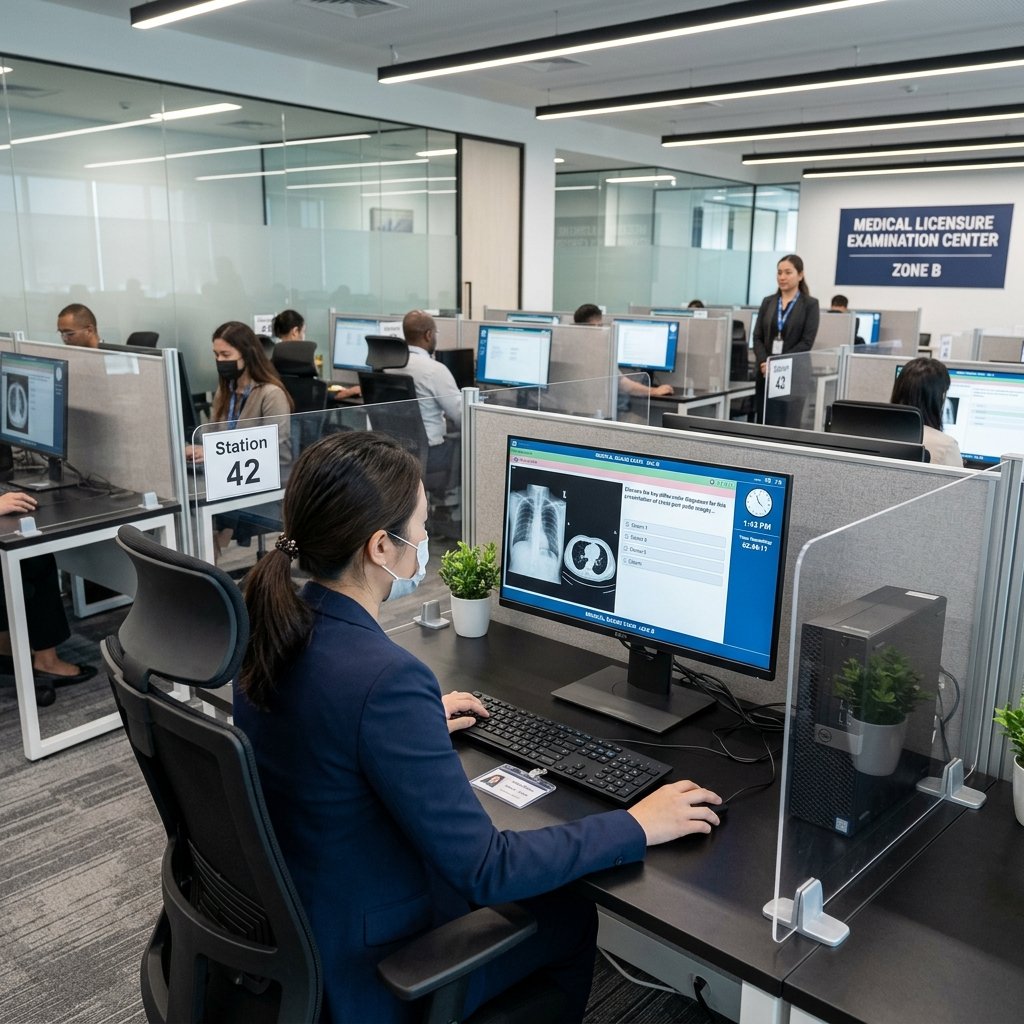
Knowing what to study is only half the battle. Knowing how you will be tested is what separates those who pass on their first attempt from those who struggle through multiple diets. The MRCP Part 1 format is rigid, exhausting, and designed to test not just your knowledge, but your clinical endurance.
Let's break down exactly what you will face on exam day so there are zero surprises.
The Structure: Two Papers, One Day
The MRCP Part 1 is a one-day, computer-based exam consisting of two separate papers. Whether you are taking it at a Pearson VUE center in London or a testing center in Dubai, the format remains identical.
- Paper 1: 100 questions, lasting exactly 3 hours.
- Lunch Break: Typically 1 hour (though this can vary slightly by center). Use this to rest your eyes, not to cram.
- Paper 2: 100 questions, lasting exactly 3 hours.
This means you are answering 200 questions over 6 hours of testing time. It is a marathon. Cognitive fatigue in Paper 2 is a very real phenomenon, which is why practicing full-length mock exams is critical.
The "Best of Five" (BOF) Format
Forget standard True/False or simple Multiple Choice Questions. The MRCP Part 1 exclusively uses a format known as "Best of Five" (BOF). Here is what that means:
You will be presented with a clinical vignette—a short paragraph detailing a patient's presentation, history, and perhaps some lab results or imaging findings. Below this, there will be five possible options.
The trick? All five options might be plausible, and several might even be technically "correct" in a broad sense. However, your job is to select the single best option for that specific clinical scenario. This requires deep clinical reasoning rather than rote memorization.
"In a Best of Five question, finding the right answer is often about eliminating the four wrong ones. Look for the nuance in the patient's age, specific lab abnormality, or the phrasing of the question."
The Golden Rule: 108 Seconds
Time management is the silent killer of MRCP candidates. Let's do the math: You have 180 minutes to answer 100 questions. That gives you exactly 1.8 minutes, or 108 seconds, per question.
In less than two minutes, you must:
- Read a paragraph of clinical data.
- Identify the core problem (spotting the "trigger words").
- Analyze five similar-looking options.
- Make a definitive decision.
If you spend 3 minutes agonizing over a difficult cardiology ECG question, you are stealing time from an easy statistics question later in the paper. The best strategy? If you don't know it within 90 seconds, make an educated guess, flag it for review if your testing software allows, and move on.
No Negative Marking
This is perhaps the best news about the MRCP Part 1 format: there is absolutely no negative marking.
You do not lose points for a wrong answer; you simply don't gain a point. Therefore, you must never leave a question blank. Even if you are completely stumped, a blind guess gives you a 20% chance of getting it right. If you can eliminate just two absurd options, your chances jump to 33%.
Understanding the format is your foundation. In our next guide, we will look at exactly when you can take this exam and how to navigate the registration process for 2026.
Master the MRCP Format with Exam Medix
Practice the "Best of Five" format under real exam conditions with our curated courses and AI assessments.